
 YatırımMasasıYatırım Masası home
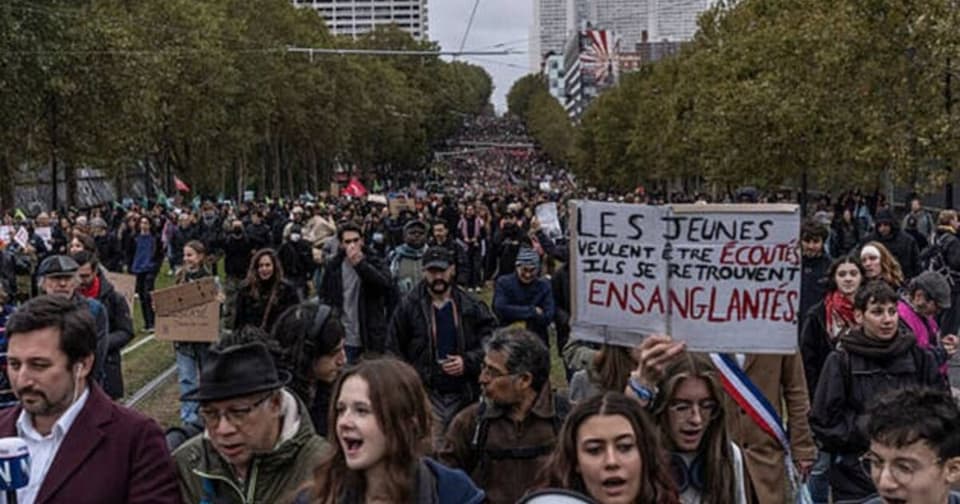
400 Thousand-Strong Protest in France Escalates Market Political Risk
 NICE
Escalating consumer price inflation (CPI) and political uncertainty in Europe's second-largest economy have once again heightened investors' risk perception toward French assets. As more than 400 thousand demonstrators took to the streets nationwide to protest the cost of living and the education budget, clashes between police and protesters increased political pressure on President Emmanuel Macron.
How did the protests in France affect the economy and businesses?
While the Ministry of the Interior reported that 410,000 people participated in the demonstrations nationwide, the organizing CGT union announced that turnout neared 800,000. After the march in Paris attended by 110,000 people turned violent, security forces used tear gas, stun grenades, and water cannons. Following the incidents, approximately 1,000 people were detained nationwide, while authorities deployed 70,000 police officers to prevent a recurrence of violent acts. Due to unrest spreading to numerous cities, notably Marseille and Lyon, demonstrations were banned in Lyon, Nice, and Montpellier.
What are the demonstrators' key economic demands from the government?
The movement, which began more than 1 month ago at a high school southeast of Paris over staffing shortages, evolved into a broad backlash against high living costs. While the consumer price inflation rate in France hovered at a 2.5-year high, energy prices rose 21.3% year-on-year in September according to data from national statistics institute INSEE, and annual consumer price inflation reached 3.1%. Student organizations are demanding 250,000 additional places in higher education, an increase in the number of teachers, an increase of 200 euros ($224) in monthly grants, and a freeze on public dormitory rents.
Street unrest also exerted direct pressure on the real economy and tourism. In Paris, retailers boarded up their shop windows while major museums shut their doors and weekend events for the Art Basel contemporary art fair were cancelled. Following the developments, the iShares MSCI France ETF (EWQ), which tracks French equities, completed the regular session down 1.01% at $41.37 before rising to $42.48 in after-hours trading. Meanwhile, the euro/dollar pair retreated 0.12% to trade at 1.12.
This content is for information purposes only and does not constitute investment advice.